
When Pool Enclosure Restoration Makes Sense in Florida
By Gian Nicolo, Owner
A pool enclosure is one of the hardest-working parts of a Florida home. It blocks insects, cuts UV exposure, catches leaves, and gives you a usable outdoor room year-round. Over ten to twenty years, sun, salt air, rain, and storm seasons slowly break down aluminum, fasteners, paint, and screen mesh. At some point, patching individual panels stops making financial sense—and pool enclosure restoration becomes the smarter path.
This guide explains how to tell the difference between normal maintenance, targeted repair, and a full restoration so you can plan ahead before small issues turn into structural problems.
What pool enclosure restoration actually includes
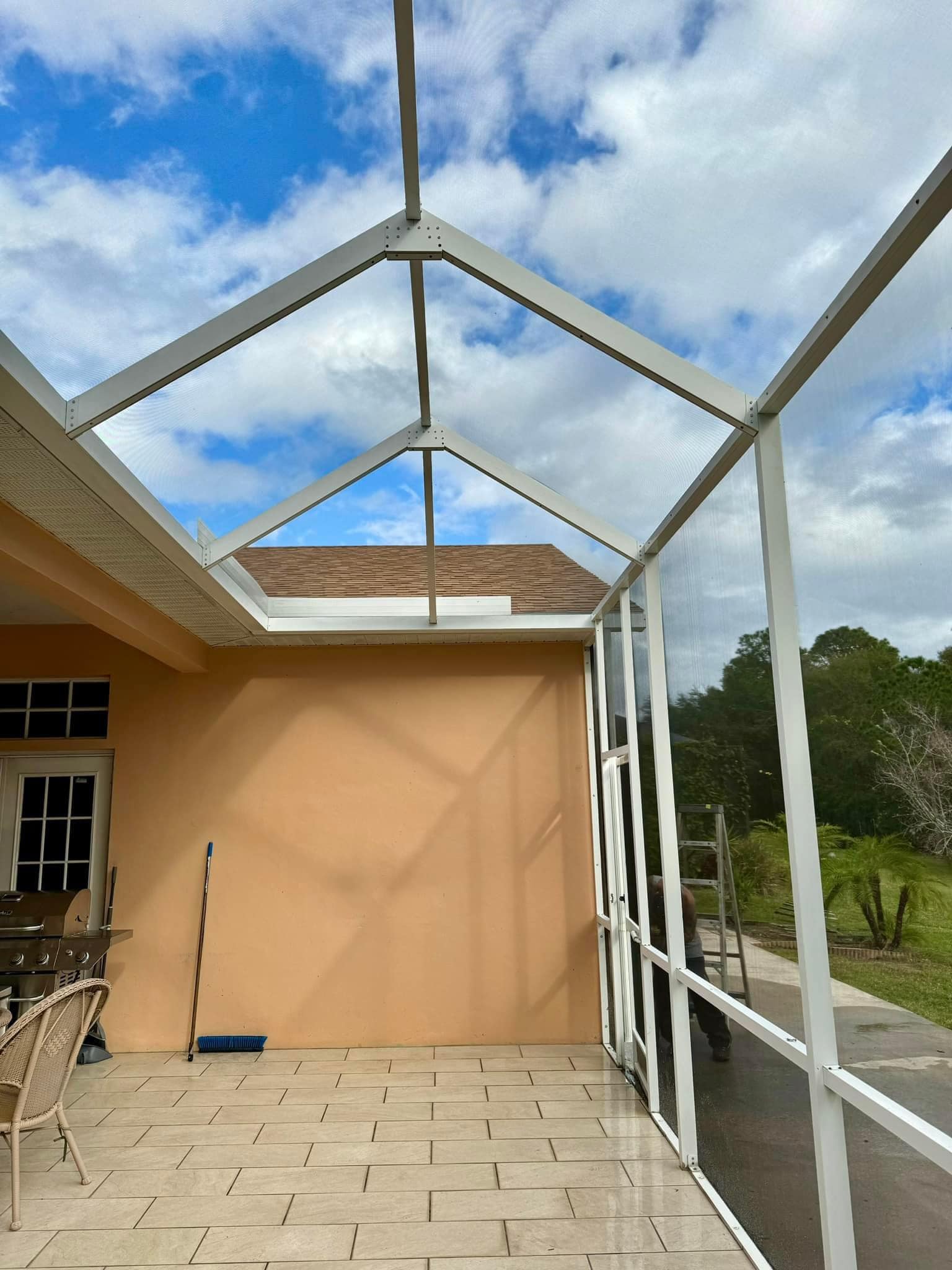
Restoration is more than swapping torn screen. A professional restoration typically addresses the whole system:
- Structural fasteners — screws and anchors that have backed out, corroded, or lost their grip in aluminum members
- Aluminum condition — oxidation (chalky white buildup), pitting, bent bars from wind loads
- Coatings — factory or field paint that has faded, peeled, or failed at welds and joints
- Screen panels — spline, mesh type, tension, and door panels
- Roof panels — often the first place algae, pollen, and leaf acids stain mesh or polycarbonate
- Doors and hardware — rollers, latches, and pet doors that no longer seal
The goal is not cosmetic touch-up alone. It is to return the cage to a stable, weathertight condition that will hold up through another decade of Florida summers.
Common problems Florida homeowners see first
Oxidation on aluminum framing
Aluminum does not rust like steel, but it does oxidize. You may notice a dull, chalky film on vertical posts and gutter tubes, especially on the south and west exposures. Oxidation weakens paint adhesion and makes hardware harder to seat properly. Once oxidation spreads across large sections, prep work before painting becomes a major part of the job.
Loose or missing screws at connections
Pool cages rely on hundreds of small fasteners. Thermal expansion daily loosens screws; wind flexing at corners accelerates the problem. A telltale sign is a rattling sound in light wind or visible gaps where a beam meets a column. Left alone, loose connections transfer load to fewer points and can bend members.
Torn, sagging, or UV-brittle screen
Screen mesh has a finite life in full sun. Standard fiberglass mesh often shows tears at knee height (pet damage), along splines (installer tension issues), or near doors (repeat flexing). When multiple panels fail in one season, rescreening alone may be appropriate—but if spline channels are cracked or frames are bent, restoration is the better scope.
Roof panel staining and organic growth
Pasco and Pinellas counties see heavy oak pollen, humid nights, and afternoon storms. Cage roofs collect a mix of algae, mildew, and leaf tannins. Pressure washing helps, but if the mesh is brittle or fasteners at the roof line are compromised, cleaning exposes deeper issues.
Storm and hurricane stress
Tampa Bay systems are designed for wind loads, but flying debris, positive pressure, and uplift can still bend kickers, pop splines, or pull tie-downs. After a named storm, homeowners often discover damage that was invisible until a panel blew out.
Signs restoration is needed (not just a patch)
Use this checklist honestly. If several apply, schedule a professional evaluation rather than another round of spot fixes.
- More than 30% of panels show tears, sag, or daylight gaps at splines.
- Oxidation is widespread and paint is peeling on multiple sides of the cage.
- Screws pull out repeatedly in the same locations after tightening.
- Doors drag or will not latch even after roller or hinge adjustment.
- Roof line looks wavy or a horizontal beam has visible bend.
- You have repaired the same corner twice after separate storm seasons.
- You plan to sell the home within two years and the enclosure is a focal point of the backyard.
Restoration costs more upfront than a single rescreen, but it resets the asset. Patching indefinitely often exceeds restoration over a three-year window.
Benefits of restoring vs replacing the entire cage
Full cage replacement is sometimes necessary when engineering is obsolete or damage is catastrophic. In many Tampa Bay homes built from the 1990s through 2010s, however, the aluminum structure is still sound—only components have aged.
Restoration advantages:
- Lower cost than tear-out and new engineering in most cases
- Less permitting complexity when footprint and height stay the same
- Shorter project timeline — many jobs complete in days, not weeks
- Preserves landscaping and decking around footings
- Improves home value presentation with uniform color and tight screen
A quality restoration also lets you upgrade mesh type (for example, no-see-um or pet screen) and refresh hurricane tie-downs where codes or insurance checklists require them.
How restoration differs from rescreening or repair alone
| Approach | Best when |
|---|---|
| Repair | One or two panels, localized storm impact, single door issue |
| Rescreening | Frame sound, paint acceptable, fasteners tight, mesh aged |
| Restoration | Widespread wear, oxidation, fastener fatigue, multiple subservices needed |
| Replacement | Bent main beams, failed footings, non-compliant design, extreme age |
Homeowners in Port Richey, Trinity, Palm Harbor, and surrounding communities often start with repair, then progress to restoration as cages reach fifteen-plus years. That progression is normal.
What to expect from a professional evaluation
A serious contractor walks the entire perimeter, taps connections, checks roof slope and drainage toward gutters, opens door panels, and probes spline retention. Photos should document oxidation, fastener type, and any bent members. You should receive a written scope that separates:
- Required structural work
- Paint and aluminum prep
- Mesh type and panel count
- Optional upgrades (pet screen, privacy mesh, gutter cleaning at cage roof)
Ask whether pressure washing is included and whether screw replacement is full or partial. Those line items change price and longevity.
Maintenance after restoration extends the payoff
After restoration, annual habits keep the cage in top shape:
- Rinse pollen season debris from roof panels
- Keep gutters and cage gutters flowing (clogged gutters dump water on door tracks)
- Inspect door latches before storm season
- Walk the perimeter after tropical storms for loose splines or tie-downs
Florida homeowners who treat the enclosure like part of the building envelope—not a disposable accessory—get the longest return.
Why local experience matters in Tampa Bay
Salt exposure near the Gulf, inland heat in Wesley Chapel and Odessa, and tree cover in New Port Richey each stress cages differently. A local crew recognizes which neighborhoods commonly need pet mesh, where HOA color standards apply, and how Pasco wind exposure differs from a sheltered Clearwater canal lot.
Screening DunRite focuses on enclosure restoration, rescreening, repair, aluminum refinishing, roof cleaning, and gutter cleaning across Pasco, Pinellas, Hernando, and Hillsborough counties. That specialization matters when you need one team to handle fasteners, paint, and mesh coherently instead of three separate trades.
Frequently Asked Questions
How long does pool enclosure restoration take?
Most residential cages in Tampa Bay take several days depending on square footage, paint cure times, and weather. Rain and humidity affect coating schedules.
Can I use my pool during restoration?
Usually yes, with brief interruptions when roof panels or doors are off. Your contractor should stage debris and protect the deck.
Is restoration covered by insurance?
Wind or impact damage may be claimable with proper documentation. General aging and oxidation are typically homeowner maintenance.
What mesh types are available at restoration?
Common options include 18/14 standard mesh, 20/20 no-see-um, pet-resistant mesh, and privacy mesh. Match mesh to sun exposure and insect pressure.
How often should a Florida pool cage be restored?
There is no fixed year for every home. Coastal homes and full-sun lots may need attention sooner than shaded inland cages. Evaluate at 12–15 years or when the checklist above triggers.
Does restoration include roof cleaning?
It can. Roof panel washing is often bundled because clean mesh and sound fasteners go together.
Final note
If your cage still has good bones, restoration is often the highest-value move you can make before considering full replacement. The right time to act is when fasteners and oxidation are trending worse each year—not after a storm removes an entire wall of panels.
Ready for a Free Pool Enclosure Evaluation?
If your pool enclosure is showing signs of aging, oxidation, loose fasteners, torn screens, fading paint, storm damage, or structural wear, now is the time to have it professionally evaluated.
Screening DunRite specializes in: Pool Enclosure Restoration Pool Cage Rescreening Pool Cage Repair Aluminum Restoration Roof Cleaning Gutter Cleaning Screen Room Restoration Lanai Rescreening
Serving homeowners throughout Port Richey, New Port Richey, Trinity, Palm Harbor, Clearwater, Odessa, Wesley Chapel, Spring Hill, Tampa, and surrounding Florida communities.
Call or Text 727-645-9575 Book Your FREE Estimate Today
Don’t wait until minor issues become major repairs. Let Screening DunRite help you protect your investment and extend the life of your outdoor living space.
Need Pool Cage Repair in Wesley Chapel? Call 727-645-9575 or book a free estimate online .