
Why Your Neighbor's Pool Cage Looks Better Than Yours (Even Though It Was Built the Same Year)
By Gian Nicolo, Owner
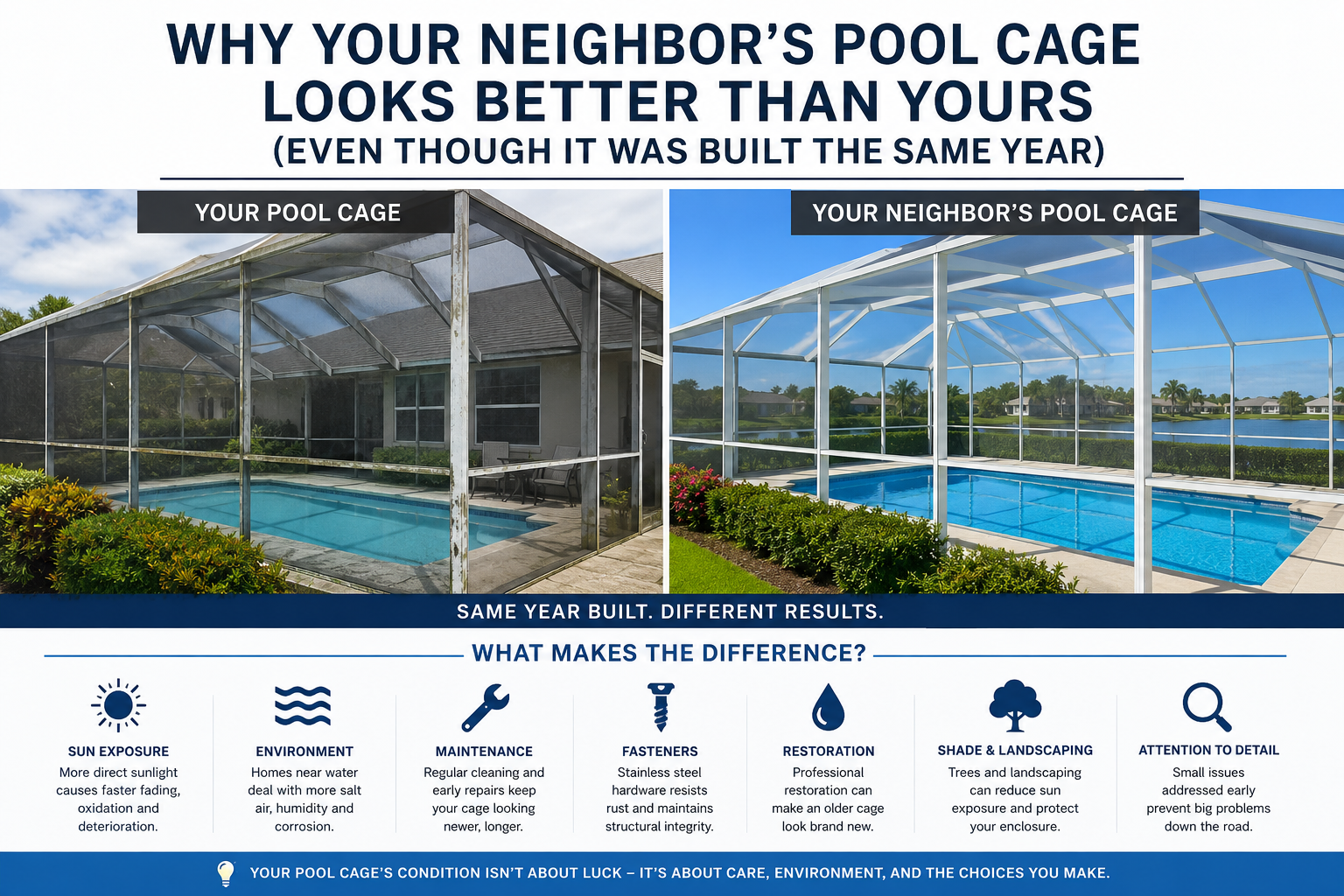
This is one of the most interesting conversations I have with homeowners.
It usually starts the same way.
The homeowner points at a neighboring property and says:
“That cage is the same age as mine.”
Then they point at their own enclosure.
And they ask:
“Why does mine look so much older?”
It’s a fair question.
And it’s one that reveals one of the biggest misunderstandings in pool cage ownership.
Because pool cages do not age equally.
Two enclosures can be:
- Built the same year
- Located in the same neighborhood
- Exposed to the same storms
And still look completely different twenty years later.
The reason has very little to do with luck.
And almost everything to do with a handful of factors most homeowners never think about.
Age Is Not the Most Important Variable
Let’s start with the biggest misconception.
Homeowners often believe age determines condition.
It doesn’t.
Age creates opportunity for deterioration.
Condition determines how much deterioration actually occurred.
Think about two identical vehicles.
One receives:
- Regular maintenance
- Routine inspections
- Proper care
The other receives almost none.
Twenty years later, those vehicles won’t be comparable.
Pool cages work the same way.
What determines pool cage lifespan in Florida has far more to do with condition and care than the year on the permit.
Sun Exposure Changes Everything
One of the biggest differences between neighboring enclosures is often something homeowners never consider.
Sun.
The Florida sun is relentless.
Some enclosures receive:
- Morning sun
- Afternoon sun
- Full-day exposure
Others benefit from:
- Tree coverage
- Home orientation
- Partial shade
The difference accumulates over years.
Particularly when it comes to:
- Oxidation
- Screen aging
- Surface deterioration
The enclosure doesn’t care how old it is.
It cares how much exposure it has received.
Why some pool cages age faster than others often comes down to sun and exposure before anything else.
The Salt Air Factor
Another huge variable is environmental exposure.
A pool cage near:
- Open water
- Coastal communities
- Bays
- Canals
often ages differently than one located farther inland.
Salt exposure accelerates:
- Corrosion
- Fastener deterioration
- Surface wear
Many homeowners underestimate this factor.
Yet it influences aging dramatically.
Two homes on the same street can age differently when one sits closer to open water — why waterfront pool cages age faster explains that gap in detail.
Maintenance Creates Separation
This is where the biggest differences usually appear.
Two homeowners.
Two identical enclosures.
One addresses:
- Small repairs
- Rust stains
- Screen damage
- Maintenance needs
The other waits.
Five years later the difference becomes visible.
Ten years later the difference becomes dramatic.
Twenty years later the structures may appear completely unrelated.
Why pool cages don’t fail all at once is the pattern behind that separation — small ignored issues compound quietly for years.
The Restoration Advantage
Many homeowners assume their neighbor’s enclosure looks better because it is newer.
Often it isn’t.
Sometimes the difference is restoration.
A properly restored enclosure may look years younger than its actual age.
This is one reason homeowners are frequently shocked when they learn how old a well-maintained enclosure actually is.
Repair, restore, or replace is often the difference between two same-year cages that look a decade apart.
Why Small Problems Matter
A tiny rust stain doesn’t seem important.
Neither does:
- A loose fastener
- A sticking door
- A small screen tear
The problem isn’t the individual issue.
The problem is what happens when those issues are ignored for years.
The homeowner who addresses small concerns usually preserves appearance much longer.
The Florida pool cage fastener problem starts as a small rust stain in one home and a structural conversation in the neighbor’s — same age, different response time.
What We Notice During Inspections
When I inspect neighboring enclosures, I often notice differences immediately.
Examples include:
Fastener Condition
Corrosion Levels
Screen Age
Door Performance
Structural Alignment
Maintenance History
Those details tell the real story.
Not the age.
Warning signs your pool cage is closer to failure are often visible side-by-side when two neighboring cages were built the same year but maintained very differently.
The Most Expensive Assumption
One of the costliest assumptions homeowners make is:
“Mine is supposed to look like this because it’s old.”
Not necessarily.
Many signs of aging are actually signs of deferred maintenance.
And deferred maintenance is different from age.
A healthy enclosure often ages remarkably well.
Waiting too long to restore a pool cage is how “normal aging” becomes the story homeowners tell themselves — while the neighbor’s cage still looks half its age.
Why Some Pool Cages Seem Timeless
The best-looking enclosures usually share several characteristics.
They’ve received:
- Regular attention
- Timely repairs
- Periodic evaluations
- Strategic restoration
Nothing revolutionary.
Just consistent care.
The result is an enclosure that continues looking younger than its years.
Chalky white oxidation is one of the clearest visual separators — the neighbor’s cage may have been addressed years ago while yours still shows every summer of sun exposure.
The Lesson Every Homeowner Should Learn
When comparing pool cages, don’t compare age.
Compare condition.
Condition determines:
- Appearance
- Performance
- Lifespan
- Future costs
Age simply provides context.
The healthiest enclosures aren’t always the newest.
They’re often the ones that were cared for the best.
Final Thoughts
The reason your neighbor’s pool cage looks better than yours may have nothing to do with when it was built.
More often than not, the difference comes down to:
- Environment
- Maintenance
- Restoration
- Ownership habits
The good news is that those things are largely within a homeowner’s control.
Because pool cages don’t simply age.
They reflect how they’ve been cared for.
And that’s why two seemingly identical enclosures can tell completely different stories twenty years later.
Why your neighbor’s pool cage survived the hurricane follows the same logic — condition and maintenance, not luck, usually explain the difference.
Call 727-645-9575 or book online.
Need Pool Cage Restoration in Palm Harbor? Call 727-645-9575 or book a free estimate online .