
Why Pool Cage Screws Rust: The Hidden Problem That Can Cost Florida Homeowners Thousands
By Gian Nicolo, Owner
Most homeowners pay attention to their screens.
They notice when a panel tears.
They notice when leaves start blowing into the pool.
They notice when bugs start finding their way inside the enclosure.
What they usually don’t notice are the hundreds—or sometimes thousands—of screws holding the entire structure together.
And that’s a problem.
Because while torn screens are easy to see, deteriorating fasteners are often hidden in plain sight.
In fact, one of the most common structural issues affecting pool enclosures throughout Florida begins with something no larger than the tip of your finger.
A screw.
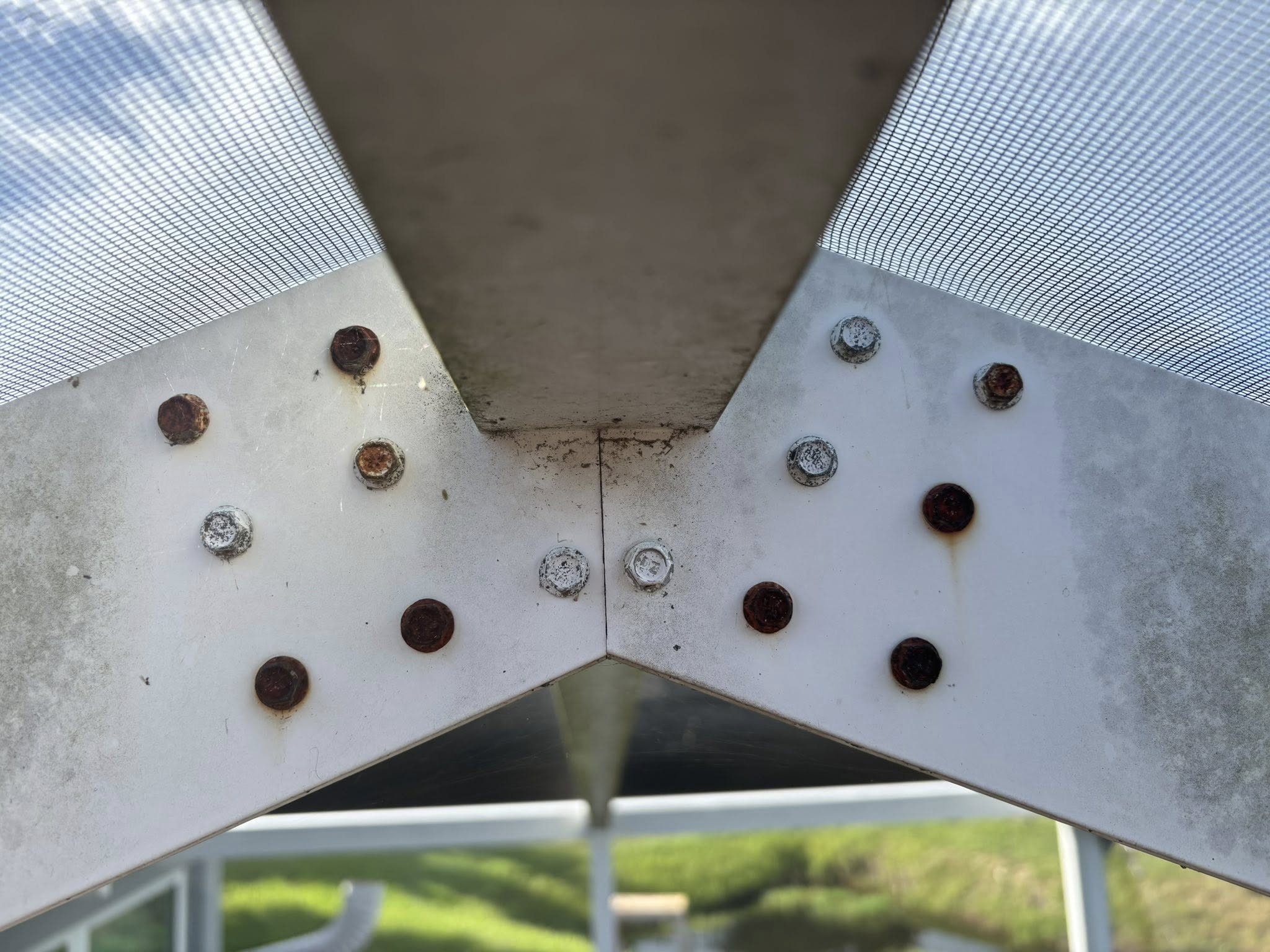
By the time homeowners notice rust stains running down the aluminum framework, the deterioration process has often been occurring for years.
Understanding why pool cage screws rust, how corrosion spreads, and what can be done to stop it may save you thousands of dollars in future repairs.
The Most Important Parts of Your Pool Cage Are Usually the Smallest
Walk around your enclosure and you’ll see large aluminum beams, vertical columns, roof supports, and screen panels.
These components are obvious.
What isn’t obvious is what holds them together.
A typical pool enclosure contains hundreds of connection points.
Each connection relies on screws and fasteners to:
- Hold structural members together
- Transfer wind loads
- Maintain alignment
- Resist movement during storms
- Support overall structural integrity
When these connections weaken, the entire enclosure becomes more vulnerable.
Think of your pool cage like a chain.
The chain is only as strong as its weakest link.
Why Rust Appears Even on Aluminum Pool Cages
Many homeowners become confused when they see rust stains on an aluminum enclosure.
After all, aluminum doesn’t rust the way steel does.
The aluminum itself usually isn’t the problem.
The screws often are.
Many older enclosures were built using fasteners that eventually become vulnerable to corrosion.
Over time, moisture and oxygen begin attacking the metal.
As corrosion develops, rust stains appear around screw heads and connection points.
Those stains are often the first visible warning sign that deterioration is occurring behind the scenes.
Florida Creates the Perfect Environment for Corrosion
If you wanted to create ideal conditions for rust and corrosion, Florida would be hard to beat.
Pool enclosure fasteners are exposed to:
- High humidity
- Frequent rainfall
- Salt-laden air
- Morning dew
- Condensation
- Storm exposure
For homeowners in Port Richey, New Port Richey, Palm Harbor, Tarpon Springs, Clearwater, and other Gulf Coast communities, salt exposure can accelerate the process even further.
Microscopic salt particles settle on metal surfaces every day.
Over time, those particles contribute to corrosion and material breakdown.
Even homeowners miles from the coast are affected.
What Is Galvanic Corrosion?
One of the most misunderstood causes of fastener deterioration is galvanic corrosion.
The term sounds complicated, but the concept is fairly simple.
When two different metals come into contact in the presence of moisture, an electrochemical reaction can occur.
Over time, one metal begins deteriorating faster than it normally would.
Florida’s humid environment provides ideal conditions for this process.
The result can be accelerated fastener failure and increased corrosion around connection points.
Many homeowners have never heard of galvanic corrosion until it becomes a costly repair issue.
The Warning Signs Most Homeowners Miss
Fastener problems rarely announce themselves dramatically.
The deterioration process is usually gradual.
Common warning signs include:
Rust Streaks — Brown or orange stains running down aluminum members.
Discolored Screw Heads — Visible corrosion around fasteners.
Missing Screws — Fasteners that have completely deteriorated or fallen out.
Loose Connections — Structural members no longer fitting tightly together.
White Oxidation Around Connections — A sign that both corrosion and oxidation may be occurring.
Many homeowners dismiss these signs as cosmetic.
Unfortunately, cosmetic symptoms often indicate larger issues beneath the surface.
Why a Single Rusted Screw Can Become a Bigger Problem
One rusted screw doesn’t seem like a major concern.
And by itself, it usually isn’t.
The problem occurs when deterioration spreads throughout the enclosure.
Remember, every connection helps distribute structural loads.
When one fastener weakens, neighboring fasteners may absorb additional stress.
Over time, more connections begin experiencing increased loads.
Eventually, multiple areas of the enclosure may become affected.
This is why professional inspections evaluate the enclosure as a system rather than focusing on individual screws.
How Hurricanes Expose Weak Fasteners
Many pool cages survive years of everyday weather.
Then a tropical storm arrives.
Suddenly screens blow out.
Structural movement occurs.
Connections fail.
The storm didn’t necessarily create the problem.
It simply exposed weaknesses that already existed.
A deteriorated fastener may function adequately during normal conditions.
However, hurricane-force winds create enormous loads.
Those loads often reveal problems that had been developing for years.
Why Fastener Replacement Is Often Part of Restoration
One of the most valuable aspects of professional pool cage restoration is addressing hidden deterioration before it becomes a major structural concern.
Many restoration projects include:
- Fastener inspections
- Corrosion assessments
- Connection evaluations
- Screw replacement
- Structural reviews
Replacing aging fasteners can significantly improve both appearance and performance.
Many homeowners are surprised by how dramatically the enclosure looks after rust stains and deteriorated screws are addressed.
Can Homeowners Prevent Fastener Problems?
While no enclosure lasts forever, homeowners can reduce risk by:
- Scheduling annual inspections
- Addressing rust stains early
- Cleaning salt and debris from the enclosure
- Monitoring connection points
- Inspecting after major storms
- Avoiding long-term neglect
Early intervention almost always costs less than major repairs.
How Often Should Fasteners Be Inspected?
Ideally:
- Once per year
- After hurricanes
- After tropical storms
- Whenever rust staining appears
Routine inspections often identify issues long before structural damage develops.
The Bottom Line
Pool enclosure screws may be small, but they play a critical role in protecting your investment.
Many homeowners focus on torn screens because they’re visible.
Professionals often focus on fasteners because they understand how important those connections are to the overall health of the enclosure.
Rust stains are rarely just cosmetic.
They’re often warning signs.
The sooner corrosion is identified and addressed, the more options homeowners typically have for restoration and repair.
Understanding the role of fasteners can help you protect your enclosure, avoid unnecessary expenses, and extend the life of your outdoor living space.
Frequently Asked Questions
Is rust on my pool cage normal?
Rust stains are common on older enclosures, but they should not be ignored.
Can rusted screws be replaced?
Yes. Fastener replacement is a common part of professional restoration projects.
Does living near the Gulf increase corrosion?
Absolutely. Salt exposure can accelerate corrosion significantly.
Should I worry about a few rust stains?
Even small rust stains can indicate larger issues developing behind the scenes.
Ready for a Free Pool Enclosure Evaluation?
If your pool enclosure is showing signs of aging, oxidation, loose fasteners, torn screens, fading paint, storm damage, or structural wear, now is the time to have it professionally evaluated.
Screening DunRite specializes in:
- Pool Enclosure Restoration
- Pool Cage Rescreening
- Pool Cage Repair
- Aluminum Restoration
- Roof Cleaning
- Gutter Cleaning
- Screen Room Restoration
- Lanai Rescreening
Serving homeowners throughout Port Richey, New Port Richey, Trinity, Palm Harbor, Clearwater, Odessa, Wesley Chapel, Spring Hill, Tampa, and surrounding Florida communities.
Call or Text 727-645-9575 Book Your FREE Estimate Today
Don’t wait until minor issues become major repairs. Let Screening DunRite help you protect your investment and extend the life of your outdoor living space.
Need Pool Cage Restoration in Dunedin? Call 727-645-9575 or book a free estimate online .