
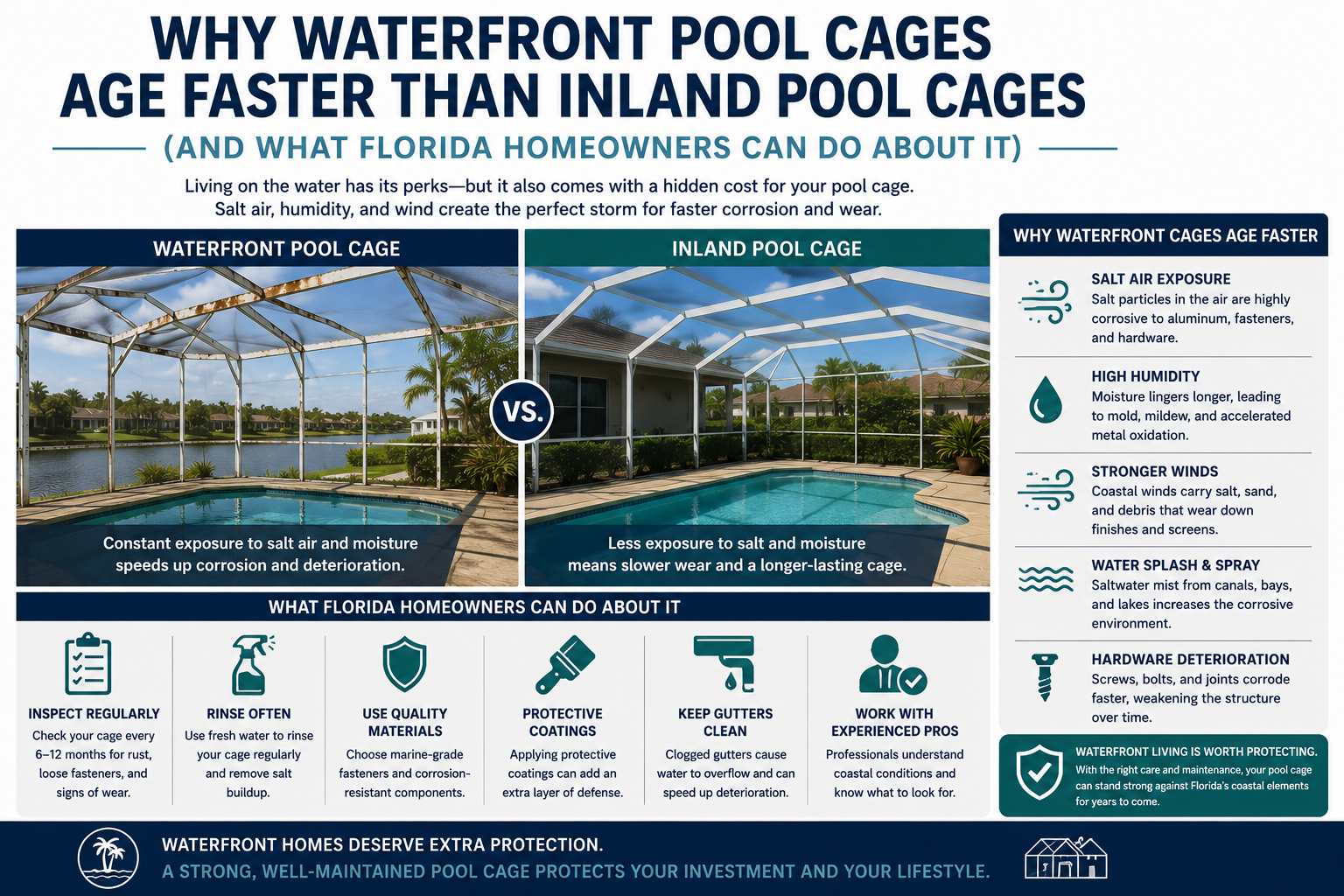
Why Waterfront Pool Cages Age Faster Than Inland Pool Cages (And What Florida Homeowners Can Do About It)
By Gian Nicolo, Owner
One of the most common questions I hear from waterfront homeowners is:
“Why does my pool cage seem to age so much faster than my friend’s enclosure?”
The answer is usually simple.
Location.
After years of inspecting pool enclosures throughout Florida, one pattern becomes impossible to ignore:
Waterfront pool cages often age differently than inland pool cages.
Not because they’re built differently.
Not because homeowners maintain them differently.
Because they live in a completely different environment.
The same factors that make waterfront living beautiful can also make pool enclosure ownership more challenging.
And understanding those factors can help homeowners dramatically extend the life of their investment.
The Million-Dollar View Comes With a Hidden Cost
Let’s start with the obvious.
Waterfront properties are incredible.
Whether your home overlooks:
- The Gulf of Mexico
- Tampa Bay
- A canal
- A lake
- An intracoastal waterway
the view is one of the property’s greatest assets.
But that same environment exposes your enclosure to conditions that inland properties often avoid.
The result is accelerated aging.
Not immediate damage.
Accelerated aging.
And that’s an important distinction.
Why some pool cages age faster than others often comes down to environment first — and waterfront homes sit on the aggressive end of that spectrum.
The Salt Air Misconception
One of the biggest myths in Florida is that salt air only affects homes directly on the beach.
It doesn’t.
Salt travels.
Wind carries microscopic salt particles surprisingly far inland.
This means homeowners living:
- Several miles from the Gulf
- Near bays
- Near waterways
may still experience elevated corrosion rates.
The amount varies.
The exposure varies.
But the impact is real.
And pool enclosures feel that impact every day.
How Florida salt air destroys pool cages explains why the damage often starts long before homeowners notice visible symptoms on the aluminum itself.
Why Fasteners Are Usually the First Victims
When environmental exposure begins affecting a pool cage, fasteners often show symptoms first.
Why?
Because they occupy the most vulnerable areas.
Connection points experience:
- Moisture
- Environmental exposure
- Temperature changes
- Salt accumulation
Over time:
- Corrosion develops
- Connections weaken
- Performance changes
This process is usually gradual.
Which is why many homeowners don’t notice it until visible symptoms appear.
The Florida pool cage fastener problem shows up earlier and more aggressively near open water — and stainless steel vs mixed-alloy screws becomes a more urgent conversation for waterfront owners than inland neighbors often realize.
The Rust Stain Warning System
Waterfront homeowners often see rust stains before they understand what they’re looking at.
Those brown streaks running down aluminum members aren’t just cosmetic.
They’re clues.
The enclosure is telling you something.
The stain itself isn’t usually the concern.
The source is.
When rust stains begin appearing, it’s often worth understanding why.
Because corrosion rarely improves on its own.
Why pool cage screws rust in Florida is one of the most common explanations behind those streaks — especially in Gulf Coast and bay-front neighborhoods.
Why Screens Age Differently Near Water
Most homeowners think of salt exposure as a metal problem.
It’s also a screen problem.
Waterfront environments often expose screen systems to:
- Salt particles
- Wind stress
- Increased UV reflection
- Environmental wear
This doesn’t mean screens fail immediately.
It means the environment places additional demands on every component of the enclosure.
Which pool cage screen lasts longest in Florida matters more when wind and salt are working against every panel year-round.
The Wind Factor Nobody Talks About
Waterfront homes often experience more than salt.
They experience wind.
Lots of it.
Open water creates:
- Stronger airflow
- Greater wind exposure
- Increased structural loading
Even outside hurricane season, these forces influence enclosure performance.
Over time, they contribute to wear.
Particularly in:
- Screens
- Connections
- Fasteners
- Doors
Why neighbors’ pool cages survive hurricanes while others do not often traces back to ongoing wind exposure and connection health — not just what happened during the storm itself.
Why Waterfront Homeowners Need Different Maintenance Strategies
One of the biggest mistakes homeowners make is using the same maintenance schedule regardless of location.
A waterfront enclosure often benefits from:
More Frequent Inspections
Earlier Corrosion Evaluations
Fastener Monitoring
Proactive Restoration Planning
The environment simply demands more attention.
Not because the enclosure is failing.
Because it’s aging faster.
A 5-minute pool cage inspection twice a year may be reasonable inland. Near open water, it is often the minimum — not the maximum.
The Difference Between Waterfront and Inland Ownership
Imagine two identical pool cages.
One sits near open water.
The other sits miles inland.
Fast forward fifteen years.
The two structures may look dramatically different.
Not because of workmanship.
Not because of ownership.
Because one enclosure spent fifteen years in a more aggressive environment.
The conditions matter.
And over time, those conditions create visible results.
Why Waterfront Homeowners Often Restore Earlier
One trend I’ve noticed repeatedly is that waterfront homeowners often restore before inland homeowners.
That isn’t a coincidence.
The environment accelerates:
- Oxidation
- Corrosion
- Surface deterioration
As a result, restoration opportunities often appear earlier.
The smart homeowners recognize this and plan accordingly.
Chalky white oxidation often appears sooner on waterfront cages — and repair, restore, or replace decisions often arrive earlier too.
The Good News
None of this means waterfront ownership is a problem.
Far from it.
The views are incredible.
The lifestyle is incredible.
The key is understanding the environment.
Because homeowners who understand their environment make better decisions.
They:
- Inspect sooner
- Maintain proactively
- Restore strategically
And as a result, they often enjoy longer enclosure lifespans.
Waterfront buyers who invest in panoramic pool cages are often protecting the view itself — and that protection only works when the structure holding the screen is maintained as aggressively as the environment demands.
What Waterfront Homeowners Should Watch For
Pay close attention to:
Rust Stains
Fastener Condition
Door Performance
Corrosion
Oxidation
Screen Wear
These indicators often appear earlier in waterfront environments.
Early awareness creates options.
Pool cage fastener replacement and warning signs your cage is closer to failure are often the difference between a manageable restoration and a full structural conversation.
Final Thoughts
Waterfront living is one of Florida’s greatest luxuries.
But it comes with responsibilities.
The same environment that creates beautiful views also creates additional stress on outdoor structures.
Pool cages are no exception.
The good news is that homeowners who understand these challenges can plan for them.
And planning is powerful.
Because the goal isn’t avoiding waterfront ownership.
The goal is protecting the investment that comes with it.
When homeowners understand how their environment affects their enclosure, they make better decisions, avoid costly surprises, and enjoy their outdoor living spaces for many years to come.
Call 727-645-9575 or book online.
Need Pool Cage Restoration in Seminole? Call 727-645-9575 or book a free estimate online .