
Why Florida Salt Air Is Quietly Destroying Your Pool Cage (Even If You Live Miles From the Water)
By Gian Nicolo, Owner
One of the biggest misconceptions Florida homeowners have is that salt air only affects homes located directly on the beach.
As someone who has inspected pool enclosures throughout Florida, I can tell you that’s simply not true.
In fact, some of the worst corrosion problems we encounter occur miles from the Gulf of Mexico.
Homeowners are often shocked when they learn that salt exposure doesn’t stop at the shoreline.
It travels.
It lingers.
And over time, it quietly attacks nearly every exposed component of a pool enclosure.
The challenge is that most homeowners never notice the damage until years later.
By then, the deterioration may already be significant.
Understanding how salt air affects pool cages is one of the most important things a Florida homeowner can learn.
Because once you understand the process, you can begin protecting against it.
The Invisible Enemy
Salt damage is different from storm damage.
Storm damage is obvious.
You see it.
You document it.
You repair it.
Salt damage is subtle.
It develops slowly.
Month after month.
Year after year.
Most homeowners never witness the process.
They only see the result.
A rust stain.
A corroded screw.
A failing connection.
A deteriorating enclosure.
What they’re seeing today often began years earlier.
How Salt Travels
Many people imagine salt air affecting only homes that sit directly on the waterfront.
In reality, airborne salt particles can travel considerable distances inland.
Wind patterns, humidity, storm systems, and seasonal weather all contribute to moving salt far beyond coastal neighborhoods.
This means homeowners living miles from the shoreline may still experience elevated corrosion rates.
The amount varies.
The exposure varies.
But the impact is real.
Coastal Tampa Bay communities — from Clearwater and St. Petersburg to Palm Harbor and New Port Richey — see this pattern repeatedly, even on homes that are not waterfront.
Why Fasteners Suffer First
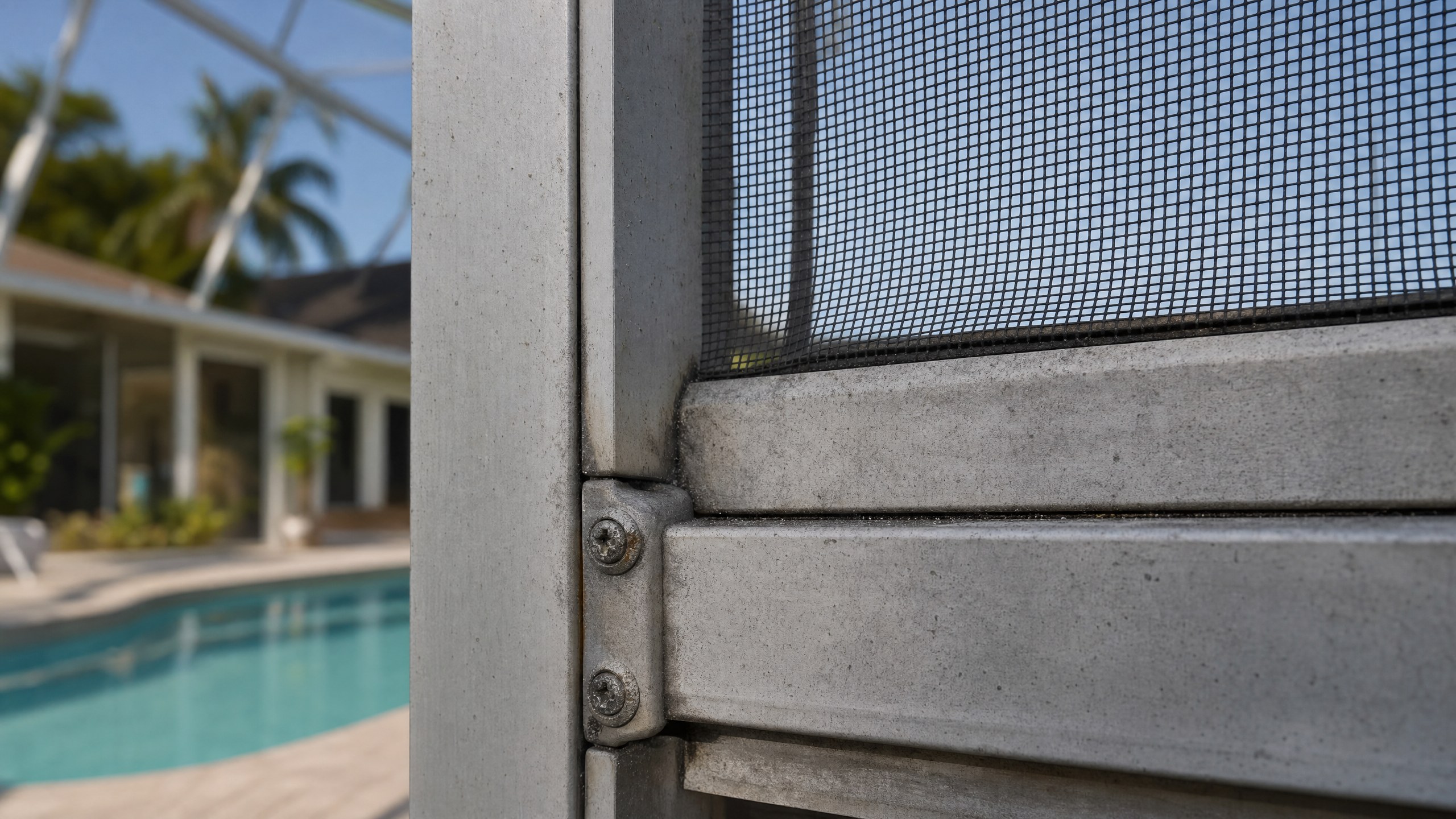
When salt begins attacking a pool enclosure, fasteners are often among the first components affected.
Fasteners create countless connection points throughout the structure.
These areas experience moisture retention, environmental exposure, thermal movement, and repeated wetting and drying cycles.
Over time, corrosion begins.
At first, it’s minor.
Then it spreads.
Eventually, structural performance can be affected.
This is why experienced inspectors pay so much attention to fastener condition.
The screws often tell the story of the entire enclosure.
Read the Florida pool cage fastener problem and why pool cage screws rust.
The Rust Stain Warning
One of the most valuable clues homeowners can look for is rust staining.
Those brown streaks running down aluminum members aren’t simply cosmetic.
They’re evidence that deterioration is occurring somewhere above the stain.
The stain itself is not usually the problem.
The source of the stain is the problem.
Think of rust stains as the enclosure’s way of asking for attention.
The sooner they’re investigated, the better.
Why Newer Pool Cages Aren’t Immune
Another common misconception is that corrosion only affects older enclosures.
Age certainly plays a role.
But environment matters too.
We’ve inspected relatively young enclosures already showing signs of accelerated deterioration.
The determining factors often include location, maintenance, exposure conditions, installation quality, and fastener systems.
Age is only one part of the equation.
Corrosion Rarely Stays in One Place
Left untreated, corrosion tends to expand.
A single deteriorating fastener can eventually affect adjacent connections, structural performance, screen systems, doors, and restoration costs.
This is one reason early intervention is so valuable.
Small corrosion issues are usually much easier to manage than widespread deterioration.
The Difference Between Surface Corrosion and Structural Corrosion
Not all corrosion is equal.
Some corrosion is primarily cosmetic.
Some corrosion affects performance.
The challenge is determining which type you’re dealing with.
This requires understanding connection systems, structural loads, fastener conditions, and environmental exposure.
This is where professional evaluations become important.
The goal is understanding what the corrosion means — not simply observing that it exists.
Why Coastal Homeowners Need a Different Maintenance Strategy
If you live near the Gulf of Mexico, Tampa Bay, the Intracoastal Waterway, or coastal waterways, your maintenance strategy should be more proactive.
Corrosion is not a matter of if.
It’s a matter of when.
Routine inspections become even more important.
Small problems become large problems faster in corrosive environments.
See pool cage inspection checklist and hidden problems found during inspections.
The Most Expensive Corrosion Mistake
Waiting.
Most homeowners don’t act when corrosion begins.
They act when corrosion becomes visible.
Those are two very different points in time.
By the time visible symptoms appear, deterioration has often been developing for years.
The smartest approach is identifying problems before they announce themselves.
Final Thoughts
Florida’s climate is one of the reasons we love living here.
It’s also one of the reasons pool enclosures require attention.
Salt air is relentless.
It doesn’t care whether your enclosure is five years old or twenty-five years old.
It doesn’t care how beautiful the enclosure looks from the patio.
Its effects are gradual, consistent, and often invisible until significant deterioration has occurred.
The homeowners who protect their investment are usually the ones who understand this process and act before the warning signs become impossible to ignore.
When it comes to corrosion, the most expensive repair is often the one that could have been prevented years earlier.
Call 727-645-9575 or book online.
Need Pool Cage Repair in Brooksville? Call 727-645-9575 or book a free estimate online .