
The Florida Pool Cage Industry Has a Fastener Problem: What Most Homeowners Don't Discover Until It's Too Late
By Gian Nicolo, Owner
If I could inspect every pool enclosure in Florida tomorrow, I can tell you exactly what I would find.
Not torn screens.
Not faded paint.
Not oxidation.
I would find deteriorating fasteners.
And most homeowners would have absolutely no idea they existed.
After years of inspecting pool enclosures, one thing has become clear:
The biggest threat to many Florida pool cages isn’t visible from the pool deck.
It’s hidden inside the structure.
It’s occurring at the connection points.
It’s happening one screw at a time.
And it’s costing homeowners thousands of dollars because almost nobody is talking about it.
The Pool Cage Industry’s Most Overlooked Component
Ask a homeowner what concerns them about their pool enclosure.
Most will say torn screens, faded paint, hurricane damage, bugs, or appearance.
Almost nobody says: “My fasteners.”
Yet fasteners are arguably the most important component in the entire enclosure.
Without them:
- Posts don’t stay connected.
- Beams don’t transfer loads.
- Braces don’t stabilize the structure.
- Doors lose alignment.
- Structural integrity declines.
The entire enclosure depends on connection points.
And those connection points depend on fasteners.
For the full technical breakdown, see pool cage fastener failure in Florida and the pool cage screw crisis.
Why Homeowners Never Think About Screws
The answer is simple.
Because they can’t see them.
Homeowners interact with doors, screens, pool decks, and outdoor furniture.
They rarely inspect structural joints, connection systems, or fastener conditions.
As a result, deterioration can continue for years without attracting attention.
That’s what makes it dangerous.
Every Pool Cage Is Constantly Under Stress
Pool enclosures move constantly — not dramatically, but continuously.
Every day they experience wind pressure, temperature changes, expansion, contraction, humidity changes, and structural loading.
Each movement places stress on connection points.
Every connection point depends on fasteners.
Why Florida Is the Perfect Environment for Fastener Deterioration
Florida creates a unique combination of challenges.
Humidity
Moisture is present almost year-round.
Salt Air
Even inland communities experience salt exposure.
Rain
Repeated wetting and drying cycles accelerate deterioration.
Heat
Extreme temperatures create movement throughout the structure.
Storm Activity
Wind loading increases stress on connections.
See why pool cage screws rust in Florida and stainless steel vs mixed alloy screws.
The Problem Doesn’t Start With Failure
Fasteners rarely fail suddenly.
The process is gradual.
Stage 1: Minor corrosion begins. Nothing appears wrong.
Stage 2: Corrosion expands. Still no obvious symptoms.
Stage 3: Connection performance begins changing. Most homeowners remain unaware.
Stage 4: Visible symptoms appear — rust stains, movement, door issues, structural concerns.
Stage 5: Major repairs become necessary.
The challenge is that homeowners usually discover the problem during Stage 4.
By then, years of deterioration may have already occurred.
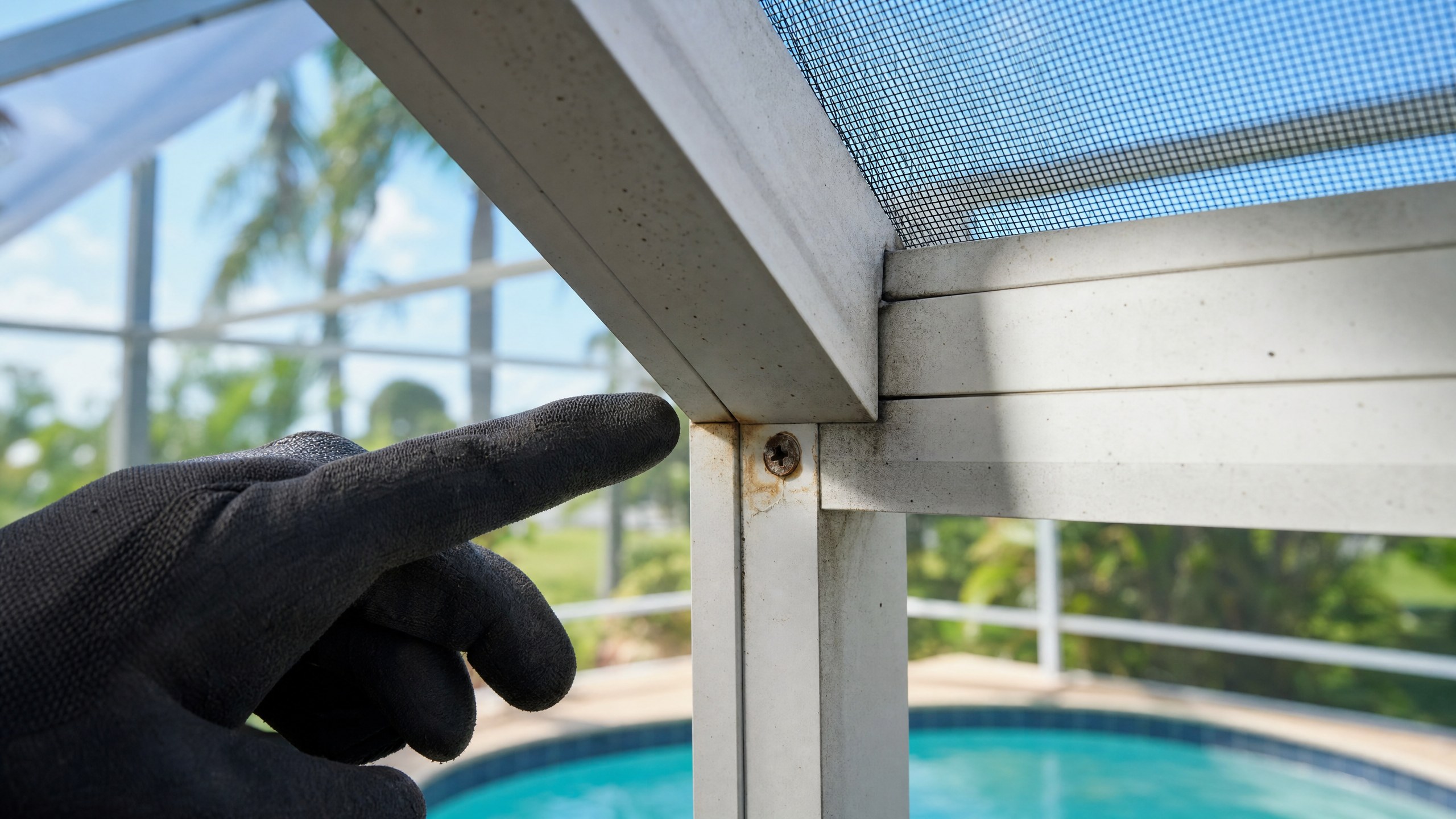
Why Rust Stains Should Never Be Ignored
One of the most misunderstood warning signs is rust staining.
Homeowners often think: “It just looks ugly.”
The stain itself isn’t usually the concern.
The source is.
A rust stain is evidence that something above the stain is deteriorating.
That doesn’t automatically mean disaster.
But it absolutely deserves investigation.
The Door Test Most Homeowners Never Realize They’re Taking
Pool cage doors tell us a tremendous amount about an enclosure.
When structural conditions change, doors often reveal it first — dragging, misalignment, latching problems, uneven gaps.
Sometimes the door is simply reporting a structural issue elsewhere.
See why your pool cage door may be telling you something.
What We Find in Older Enclosures
As enclosures age, we frequently discover corroded hardware, connection deterioration, previous repair issues, structural movement, and deferred maintenance.
Many of these enclosures still look fine from a distance.
A clean pool cage is not necessarily a healthy pool cage.
Read hidden problems we find during most inspections.
The Cost of Ignoring Connection Systems
A deteriorating connection may eventually contribute to structural repairs, door repairs, screen failures, restoration projects, and reduced storm performance.
The original issue may have been inexpensive to address.
The resulting repairs often aren’t.
See pool cage fastener replacement guide.
Why Some Pool Cages Reach 30 Years
When people ask why some enclosures seem to last forever, the answer is usually a combination of quality construction, healthy fasteners, routine inspections, prompt maintenance, and early intervention.
Small problems stay small only when they’re addressed.
The Smartest Question a Homeowner Can Ask
Instead of asking “Does my pool cage need repair?” ask:
“What condition are the connection systems in?”
That question often reveals far more than looking at screens or paint.
Because ultimately, a pool cage is not a screen structure.
It’s a structural system.
And structural systems depend on connections.
Final Thoughts
Most homeowners worry about what they can see.
Professionals worry about what they can’t.
The future performance of a pool enclosure is often determined long before obvious symptoms appear.
When it comes to pool cages, the most important components are often the ones hiding in plain sight.
Call 727-645-9575 or book online.
Need Pool Cage Repair in Seminole? Call 727-645-9575 or book a free estimate online .