
Why Florida Pool Cages Don't Fail All At Once: The Slow Deterioration Process Every Homeowner Should Understand
By Gian Nicolo, Owner
One of the biggest misconceptions homeowners have about pool cages is how failure actually occurs.
Most people imagine a dramatic event.
A hurricane.
A collapse.
A major storm.
A sudden structural problem.
The reality is very different.
Most pool cages don’t fail overnight.
They don’t wake up one morning and decide to become unsafe.
They deteriorate slowly.
Quietly.
Often invisibly.
In fact, many of the major restoration projects we perform began as minor maintenance issues years earlier.
That’s what makes pool cage deterioration so dangerous.
It’s gradual enough to ignore.
Until it isn’t.
Understanding how pool enclosures actually age may be the single most valuable thing a Florida homeowner can learn.
Because once you understand the process, you begin seeing warning signs differently.
And that can save thousands of dollars over the life of your enclosure.
The Pool Cage Isn’t a Single Structure
One reason homeowners misunderstand deterioration is because they think of the enclosure as one thing.
It isn’t.
A pool cage is actually a collection of systems working together.
Those systems include:
- Structural aluminum
- Fasteners
- Connections
- Screen systems
- Doors
- Roof systems
- Attachment points
Each ages differently.
Each deteriorates differently.
And each influences the others.
This is why professional inspections evaluate the entire enclosure rather than focusing on a single issue.
Read the Florida pool cage inspection report: what homeowners are most surprised to learn.
Stage One: The Invisible Years
This is where deterioration begins.
And it’s where homeowners almost never notice it.
The enclosure still looks good.
The screens are intact.
The doors function normally.
Nothing appears wrong.
Meanwhile:
- Moisture is present.
- Corrosion begins.
- Fasteners age.
- UV exposure continues.
- Materials slowly change.
No alarms go off.
No obvious symptoms appear.
This stage can last for years.
See why some Florida pool cages age faster than others.
Stage Two: Early Warning Signs
Eventually the enclosure begins leaving clues.
Most homeowners dismiss them.
Examples include:
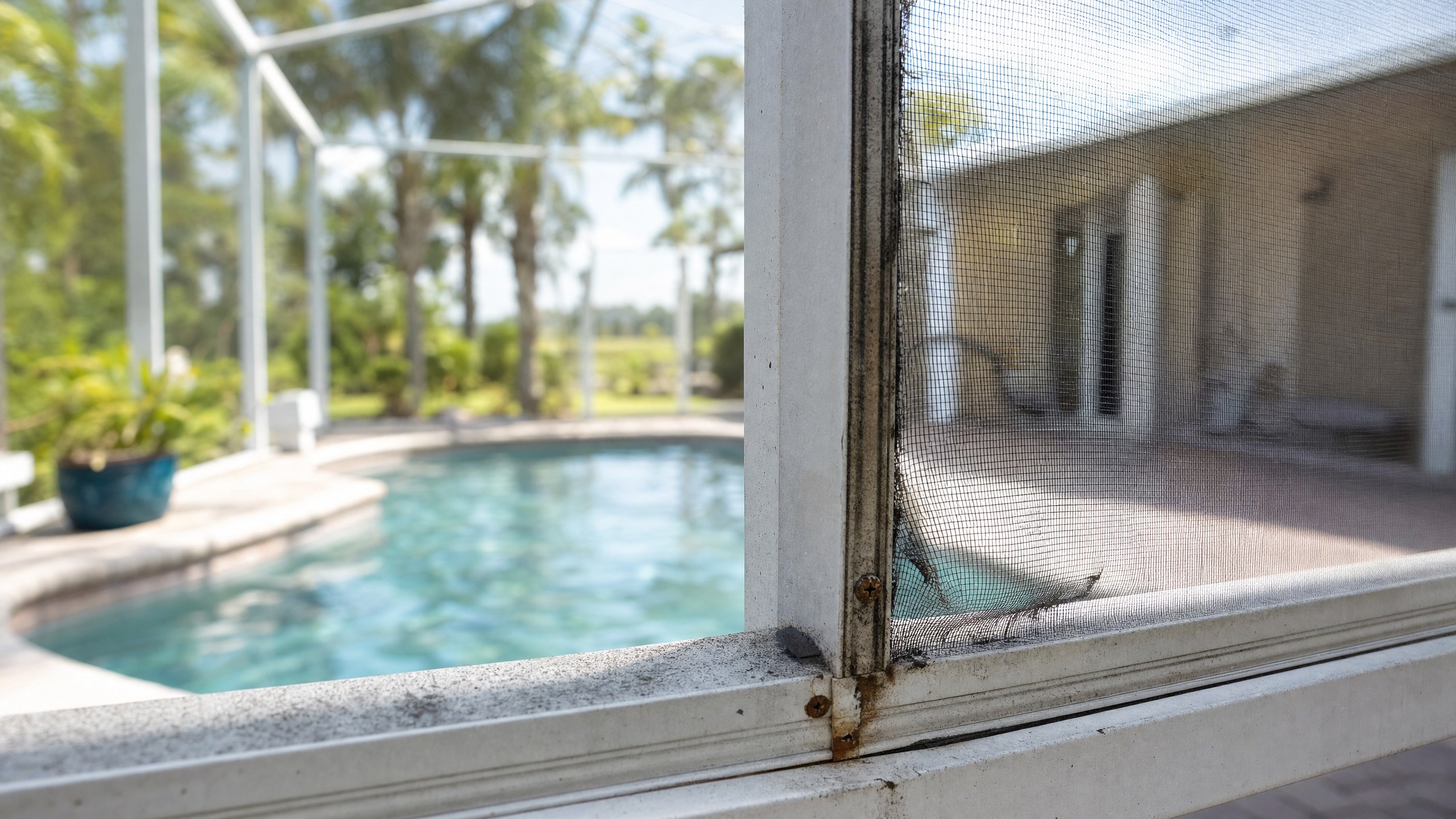
Small Rust Stains
Often viewed as cosmetic.
Minor Door Issues
Nothing serious.
Just slightly annoying.
A Few Torn Screens
Easy to ignore.
Small Areas of Oxidation
Common in Florida.
Individually, none of these symptoms seem urgent.
Collectively, they tell a story.
The enclosure is changing.
Read pool cage door warning signs and pool cage clues in the first 60 seconds.
Stage Three: The Acceleration Phase
This is where deterioration becomes more noticeable.
Problems begin interacting with one another.
A corroded fastener may contribute to:
- Structural movement
- Screen stress
- Alignment issues
A door problem may reveal:
- Connection issues
- Load changes
- Structural movement
This is often the stage where homeowners begin calling contractors.
Unfortunately, the process has usually been underway for years by this point.
Why Corrosion Doesn’t Stay in One Place
One of the most important concepts homeowners should understand is that deterioration tends to spread.
Rarely does corrosion remain isolated forever.
A connection deteriorates.
Performance changes.
Stress shifts.
Additional components become affected.
This is why early intervention is so valuable.
Small problems are easier to contain.
Large problems often involve multiple systems.
See the fastener problem most Florida pool cage owners don’t know about.
The Hurricane Misunderstanding
Many homeowners believe hurricanes create most pool cage problems.
That’s only partially true.
More often, hurricanes expose existing problems.
Think of a hurricane as a stress test.
Healthy structures perform differently than deteriorated structures.
The storm reveals:
- Weak connections
- Corroded fasteners
- Deferred maintenance
- Hidden structural concerns
The hurricane may appear to be the cause.
In reality, it often reveals issues that already existed.
Read the hidden problems found on most pool cage inspections.
Why Homeowners Miss the Warning Signs
The answer is simple.
The changes happen slowly.
Human beings are remarkably good at adapting to gradual change.
A homeowner sees the enclosure every day.
Because of that, subtle deterioration often goes unnoticed.
This is why professional inspections are so valuable.
Inspectors see the enclosure differently.
They’re looking for:
- Patterns
- Symptoms
- Indicators
- Early-stage concerns
Things homeowners naturally overlook.
Run a 5-minute pool cage inspection between professional evaluations.
The Most Dangerous Phase
Interestingly, the most dangerous phase isn’t severe deterioration.
It’s moderate deterioration.
Why?
Because that’s when homeowners often believe everything is fine.
The enclosure still functions.
Nothing seems urgent.
Yet meaningful deterioration is occurring.
This is the period when inspections create the most value.
Because options are still available.
Repairs remain manageable.
Restoration remains practical.
Read how much pool cage restoration costs in Florida.
The Difference Between Aging and Failure
This distinction matters.
Every enclosure ages.
Not every enclosure is failing.
Aging includes:
- Cosmetic changes
- Screen wear
- Oxidation
- Normal environmental effects
Failure involves:
- Structural concerns
- Connection problems
- Significant deterioration
- Reduced performance
The challenge is knowing where one ends and the other begins.
That’s why evaluations matter.
See what actually determines pool cage lifespan in Florida.
What the Best Pool Cage Owners Understand
The homeowners who get the most life from their enclosures usually understand one thing:
Problems are cheapest when they’re smallest.
They don’t wait for major symptoms.
They:
- Inspect
- Maintain
- Restore strategically
- Address concerns early
As a result, their enclosures often last significantly longer.
The Most Expensive Sentence in Pool Cage Ownership
It’s a sentence I hear constantly.
“It doesn’t seem that bad.”
Those words have probably cost Florida homeowners millions of dollars over the years.
Because deterioration rarely looks serious at first.
That’s exactly why it’s ignored.
The earlier a concern is identified, the more choices exist.
The longer it remains ignored, the fewer choices remain.
Before hiring anyone, use 25 questions every homeowner should ask a pool cage contractor.
Final Thoughts
Pool cages don’t fail all at once.
They fail gradually.
One connection.
One fastener.
One overlooked warning sign at a time.
The good news is that most major problems begin as small problems.
And small problems are usually manageable.
The homeowners who understand this process make better decisions.
They inspect earlier.
Maintain more effectively.
Restore more strategically.
And ultimately spend less money over the life of their enclosure.
Because when it comes to pool cages, the most expensive repairs are often the ones that could have been prevented years earlier.
Call 727-645-9575 or book online.
Need Pool Cage Repair in Clearwater? Call 727-645-9575 or book a free estimate online .