
The Pool Cage Inspection Nobody Wants: 7 Signs Your Enclosure May Be Closer to Failure Than You Think
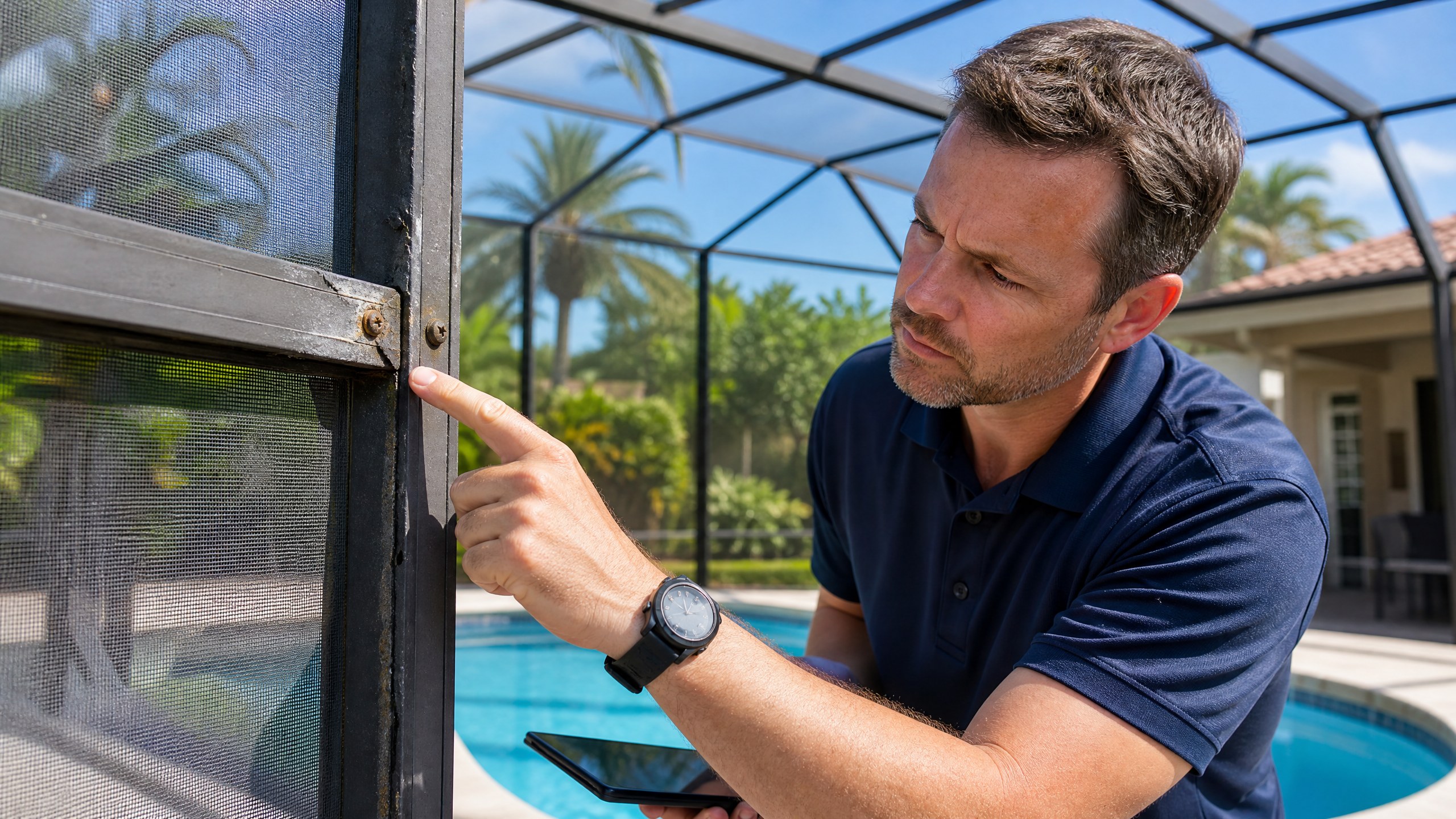
By Gian Nicolo, Owner
There is a particular type of inspection every pool enclosure owner hopes they never need.
It’s the inspection where the homeowner says:
“Gian, I think something may be wrong.”
Most of the time, they’re hoping I’ll tell them everything is fine.
Sometimes I do.
Sometimes I don’t.
What surprises many homeowners is that serious pool cage problems rarely announce themselves with dramatic failures.
Most structural concerns begin quietly.
A small rust stain.
A sticking door.
A few torn screens.
Minor movement.
Subtle changes that seem insignificant at the time.
The challenge is that pool cages don’t usually fail overnight.
They deteriorate gradually.
And because the deterioration happens slowly, many homeowners don’t recognize the warning signs until major repairs become necessary.
If your enclosure is showing any of the following signs, it may be time for a professional evaluation.
Not because failure is imminent.
But because the earlier issues are identified, the more options homeowners typically have.
Warning Sign #1: Rust Stains Are Appearing Throughout the Enclosure
This is one of the most common warning signs we encounter.
Many homeowners view rust stains as cosmetic.
They’re often much more important than that.
Rust stains frequently indicate:
- Fastener deterioration
- Corrosion
- Moisture intrusion
- Connection problems
The stain itself is rarely the concern.
The source is.
One isolated stain may not be significant.
Multiple stains appearing throughout the enclosure often deserve further investigation.
The sooner the source is identified, the easier it usually is to address.
Read the Florida pool cage industry’s fastener problem and pool cage fastener replacement.
Warning Sign #2: The Door Doesn’t Close Like It Used To
Pool cage doors are remarkably honest.
They reveal changes quickly.
A door that suddenly:
- Drags
- Sticks
- Won’t latch properly
- Requires force to close
may be telling you something important.
Many homeowners assume they need a new latch or hinge.
Sometimes they do.
Other times the door is reporting structural movement elsewhere in the enclosure.
A door problem isn’t always a door problem.
That’s why it deserves attention.
See why your pool cage door may be telling you something.
Warning Sign #3: Screen Panels Keep Tearing
One torn panel is usually not a major concern.
Repeated screen failures are different.
If you’re constantly replacing:
- Panels
- Spline
- Screen sections
there may be a larger issue contributing to the problem.
Potential causes include:
- Aging materials
- Structural movement
- Storm stress
- Installation issues
The goal isn’t simply replacing the screen.
The goal is understanding why the failures keep occurring.
Compare full rescreening vs individual panel replacement and read the real cost of ignoring a small screen tear.
Warning Sign #4: The Enclosure Looks Different Than It Did a Year Ago
This sounds simple.
But it’s important.
Many homeowners notice:
- Sagging areas
- Uneven lines
- New gaps
- Distorted sections
without fully understanding what they’re seeing.
Changes in appearance often indicate changes in condition.
A pool cage should maintain its geometry.
When that geometry changes, it’s worth investigating why.
Warning Sign #5: You See White Chalky Residue Everywhere
This is oxidation.
And while oxidation is often cosmetic, it still tells us something.
It tells us:
- The enclosure is aging
- Protective finishes are deteriorating
- Environmental exposure is taking its toll
Heavy oxidation doesn’t automatically indicate structural concerns.
But it often signals that the enclosure deserves evaluation and possibly restoration.
Ignoring oxidation rarely improves the situation.
Learn more in pool cage oxidation: what Florida homeowners should know.
Warning Sign #6: The Enclosure Hasn’t Been Professionally Evaluated in Years
This may be the biggest warning sign of all.
Not because something is necessarily wrong.
Because nobody knows.
Many homeowners haven’t had their pool cage professionally evaluated in:
- Five years
- Ten years
- Fifteen years
Meanwhile, Florida weather continues working every day.
The absence of an inspection doesn’t mean the absence of deterioration.
It simply means the condition remains unknown.
See what most pool cage contractors miss during an inspection and the 10 things I can tell about your pool cage in 60 seconds.
Warning Sign #7: The Pool Cage Survived a Hurricane and Hasn’t Been Inspected Since
This is incredibly common.
The storm passes.
The enclosure remains standing.
The homeowner assumes everything is fine.
Sometimes it is.
Sometimes hidden issues remain.
Storms can create:
- Connection stress
- Fastener problems
- Structural movement
- Minor damage that becomes larger over time
A post-storm inspection often reveals concerns that would otherwise remain hidden.
The strongest pool cages aren’t the ones that never experience storms.
They’re the ones that are evaluated after storms.
Read what to inspect the day after a hurricane and why your neighbor’s cage survived the storm.
The Most Dangerous Pool Cage in Florida
It’s not necessarily the oldest.
It’s not necessarily the most damaged.
It’s often the pool cage nobody has looked at in years.
Because deterioration doesn’t stop simply because nobody is paying attention.
The enclosure continues aging whether inspections occur or not.
The difference is that inspections identify problems while they’re still manageable.
See why Florida homeowners wait too long to restore their pool cage.
What We Often Hear From Homeowners
One of the most common phrases we hear is:
“I thought it was normal.”
And sometimes it is.
The challenge is that homeowners shouldn’t have to guess.
A professional evaluation provides clarity.
The objective isn’t creating fear.
The objective is replacing uncertainty with information.
The Good News
Most pool cage issues are not emergencies.
Most concerns develop gradually.
And most homeowners have more options than they realize.
The key is identifying concerns before they become major repairs.
That’s where inspections create value.
Not because they find problems.
Because they find problems early.
Start with a 5-minute pool cage inspection, then schedule a professional evaluation when warning signs appear.
Final Thoughts
The best time to inspect a pool cage isn’t after a major failure.
It’s before one occurs.
If your enclosure is showing any of these warning signs, it doesn’t automatically mean something is wrong.
It simply means the enclosure deserves attention.
The homeowners who spend the least over the life of their pool cages are usually the ones who identify issues early, make informed decisions, and stay ahead of deterioration.
Because when it comes to pool enclosures, the most expensive problems are rarely the ones you see coming.
They’re the ones that develop quietly while nobody is looking.
Before hiring anyone, use 25 questions every homeowner should ask a pool cage contractor.
Call 727-645-9575 or book online.
Need Pool Cage Repair in Clearwater? Call 727-645-9575 or book a free estimate online .