
Pool Cage Fastener Replacement: The Most Important Service Most Florida Homeowners Have Never Heard Of
By Gian Nicolo, Owner
If you ask the average Florida homeowner what the most important part of a pool enclosure is, you’ll usually hear one of three answers:
- The screen
- The aluminum structure
- The roof system
Almost nobody says:
“The screws.”
And that’s exactly why so many homeowners miss one of the most important maintenance opportunities available for their enclosure.
After years of inspecting pool cages throughout Florida, I can confidently say that fasteners are one of the most overlooked components in the entire structure.
Yet they are often the difference between an enclosure that performs well for decades and one that develops expensive structural problems much earlier than it should.
The challenge is that most homeowners don’t even know there is a problem until visible symptoms begin appearing.
By then, deterioration may have been occurring for years.
What Is Pool Cage Fastener Replacement?
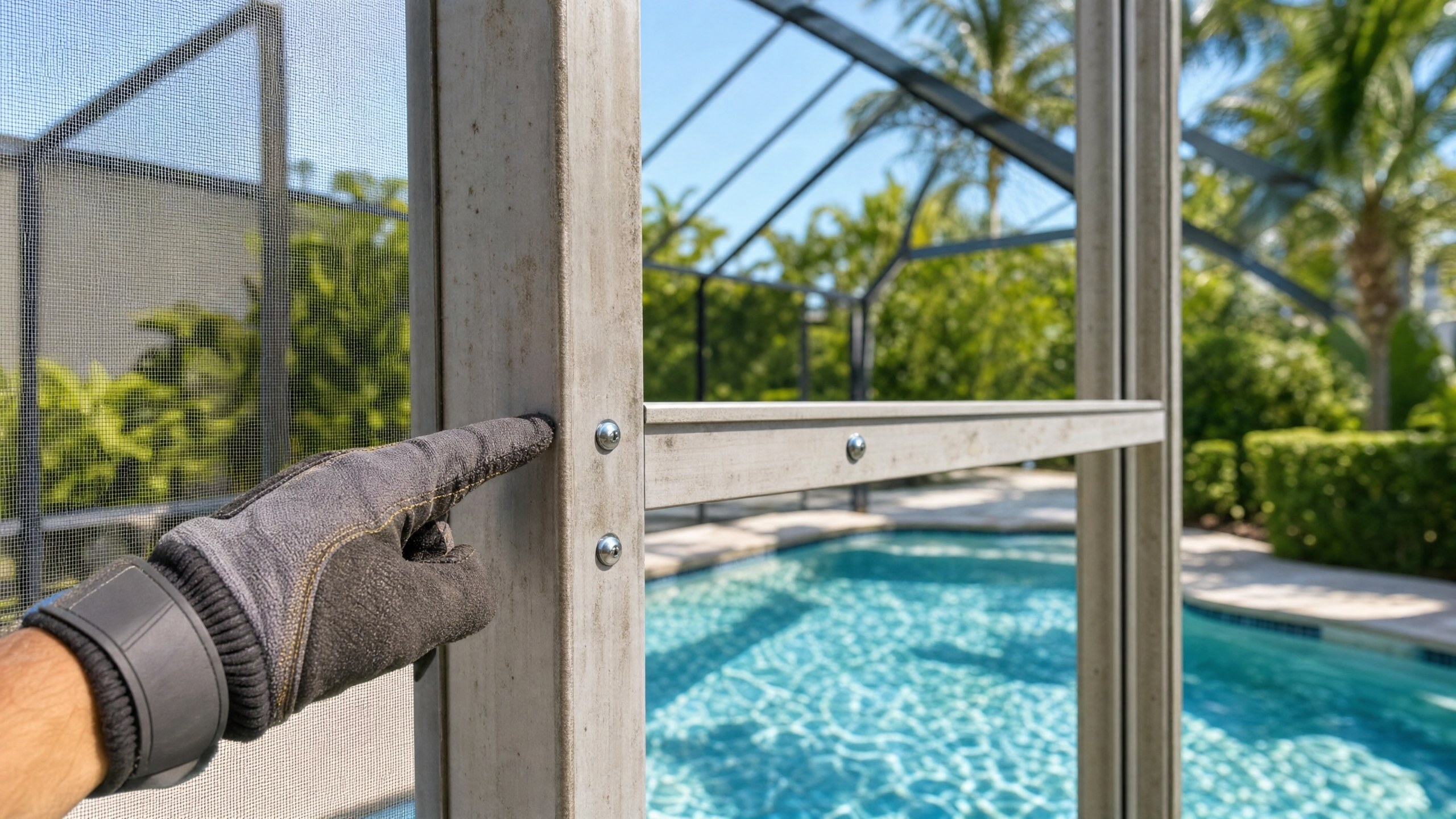
Fastener replacement is the process of removing deteriorated hardware and replacing it with new fasteners designed to improve structural integrity and long-term performance.
This may sound simple.
It’s not.
Every pool enclosure contains hundreds—and often thousands—of connection points.
These connections hold together:
- Posts
- Beams
- Braces
- Door frames
- Roof systems
- Structural attachments
Without healthy fasteners, the enclosure cannot perform as intended.
Why Fasteners Matter More Than Homeowners Realize
Imagine building a house where every connection is slowly weakening.
The walls may still stand.
The roof may still look fine.
The paint may still look good.
But eventually, the connections begin affecting the entire structure.
That’s exactly what happens in many aging pool enclosures.
The enclosure often appears healthy from a distance.
Meanwhile, hidden deterioration continues developing at the connection points.
Read the Florida pool cage industry’s fastener problem for how this develops in stages.
Florida Is Extremely Hard on Fasteners
Pool cages exist in one of the harshest environments in America.
Every day they experience:
Humidity
Moisture accelerates corrosion.
Rain
Repeated wetting and drying cycles create stress.
Salt Air
Particularly damaging near coastal communities.
See why Florida salt air destroys pool cages miles from the water.
UV Exposure
Heat contributes to expansion and contraction.
Wind
Even normal wind places loads on connections.
Over time, these conditions affect nearly every exposed fastener.
The process is gradual.
Which is exactly why homeowners often miss it.
The First Warning Signs
Most fastener problems don’t begin with structural failure.
They begin with subtle clues.
Examples include:
Rust Stains
One of the most common indicators.
Brown streaks running down aluminum members often suggest deterioration above.
Loose Components
Connections may begin losing rigidity.
Door Alignment Changes
Doors frequently reveal movement before homeowners notice anything else.
Read why your pool cage door may be telling you something.
Repeated Screen Failures
Sometimes deteriorating connections contribute to recurring screen problems.
These symptoms deserve attention.
Not because disaster is imminent.
But because they indicate change.
Why Rust Stains Are So Important
Rust stains deserve special attention.
Homeowners often view them as cosmetic.
Professionals view them as evidence.
The stain itself is rarely the issue.
The source of the stain is what matters.
That source may involve:
- Corroded fasteners
- Connection deterioration
- Moisture intrusion
- Long-term environmental exposure
The sooner the source is identified, the easier it usually is to address.
Learn more in why pool cage screws rust in Florida.
The Coastal Florida Problem
Homeowners near:
- Tampa Bay
- Clearwater
- St. Petersburg
- Palm Harbor
- Dunedin
- Tarpon Springs
- New Port Richey
- Hudson
often experience accelerated corrosion.
Salt air doesn’t remain at the shoreline.
It travels.
And over time it affects pool enclosures throughout the region.
Many homeowners are surprised to learn their enclosure is experiencing coastal-style corrosion even though they don’t live directly on the water.
What Happens If Fasteners Are Ignored?
Nothing.
At first.
That’s what makes the problem dangerous.
Deterioration usually develops slowly.
Then one day homeowners begin noticing:
- Rust stains
- Structural movement
- Alignment issues
- Connection problems
- Restoration needs
The deterioration didn’t start that day.
It simply became visible that day.
The Difference Between Cosmetic and Structural Concerns
Not every corroded fastener creates a structural emergency.
But every deteriorating fastener deserves evaluation.
The goal is determining:
- Extent of corrosion
- Location
- Impact on performance
- Long-term implications
This is where inspections become valuable.
Because appearance alone rarely tells the full story.
See the hidden problems found on most pool cage inspections.
Why Fastener Replacement Is Often Part of Restoration
One of the biggest mistakes homeowners make is focusing exclusively on appearance.
A beautiful paint job doesn’t improve a deteriorating connection.
A new screen doesn’t improve a deteriorating connection.
A restored enclosure should address both:
- Appearance
- Structural health
This is why many comprehensive restoration projects include fastener evaluation and replacement.
The objective isn’t simply making the enclosure look newer.
It’s improving its overall condition.
Compare stainless steel vs mixed-alloy pool cage screws and read what drives pool cage restoration costs.
The Homeowners Who Benefit Most
Fastener evaluations are particularly valuable for:
Older Pool Cages
Age increases the likelihood of deterioration.
Coastal Homes
Salt exposure accelerates corrosion.
Hurricane-Exposed Properties
Storm loading stresses connection systems.
Homes Showing Rust Stains
Rust stains are often early warning signs.
Homeowners Planning Restoration
Understanding structural condition should always come before cosmetic improvements.
The Best Time to Evaluate Fasteners
Before there is a problem.
This is true of almost every maintenance issue.
The earlier concerns are identified:
- The more options exist
- The lower costs often remain
- The better long-term outcomes usually become
Waiting until visible damage appears rarely improves the situation.
Final Thoughts
Pool cage fasteners may be the most important component most homeowners never think about.
They’re hidden.
They’re easy to ignore.
And they’re responsible for holding the entire structure together.
The strongest pool cages aren’t simply the ones with the newest screens or the nicest paint.
They’re the ones with healthy connection systems.
Because ultimately, a pool cage is only as strong as the hardware holding it together.
And that makes fastener condition one of the most important things any Florida homeowner can understand.
For broader context, see pool cage fastener failure in Florida and the complete Florida pool cage homeowner’s guide.
Call 727-645-9575 or book online.
Need Pool Cage Repair in Hudson? Call 727-645-9575 or book a free estimate online .